How to Design Scalable Database Architecture: A Complete Guide
When traffic spikes and systems crash, the financial fallout can be brutal—sometimes costing businesses thousands of dollars a minute. More often than not, the real bottleneck isn’t your shiny frontend framework or your backend application code. It’s the database itself. If your app buckles under the weight of concurrent users, figuring out how to design scalable database architecture isn’t just an option; it’s a necessity.
Standard, single-server setups work fine at first, but they quickly morph into massive bottlenecks as your data footprint expands. Suddenly, you’re dealing with agonizingly slow queries, erratic latency spikes, or—worst of all—complete downtime. Figuring out how to efficiently scale that data layer is the only way to guarantee the always-on, seamless experience your users expect.
Throughout this guide, we’re going to break down the core concepts behind database scaling. We’ll look closely at what technically drives these performance bottlenecks, share some immediate optimizations you can roll out today, and dive into the advanced strategies top-tier engineers use to future-proof their distributed systems.
Why You Need to Know How to Design Scalable Database Architecture
Almost every application kicks off its lifecycle relying on a single, monolithic database. Early on, this makes perfect sense. It’s easy to manage, guarantees strong data consistency, and keeps deployment simple. But as your user base begins to multiply, that monolithic setup is going to hit a brick wall.
Picture a sudden surge in traffic. Your database server starts sweating, maxing out CPU utilization, bumping against memory limits, and struggling with disk I/O constraints. Soon, concurrency issues pop up. Multiple transactions end up fighting for the exact same row locks, forcing incoming requests to sit in ever-growing queues. Give it enough time, and those queues simply time out, leaving your users staring at error screens.
The traditional knee-jerk reaction is to throw better hardware at the problem. We call this vertical scaling (or scaling up). It usually involves migrating your database over to a beefier server packed with more RAM, lightning-fast NVMe storage, and a higher-core CPU. Make no mistake, it works great as a short-term band-aid. However, vertical scaling comes with a hard physical limit and an eye-watering price tag.
If you want to comfortably handle enterprise-level traffic, your system will eventually need to embrace horizontal scaling (scaling out). Rather than leaning on one giant supercomputer, horizontal scaling spreads your data and traffic load across a fleet of interconnected servers. Of course, designing this kind of distributed ecosystem brings a whole new set of complexities to the table. That’s exactly why you need a highly deliberate architectural strategy.
Quick Fixes / Basic Solutions
Before you completely tear down your infrastructure to build a complex distributed architecture, take a step back and optimize what you already have. Believe it or not, what looks like a hard scaling limit is often just a poorly optimized database structure in disguise. Here are a handful of actionable fixes you can deploy to boost database performance right now.
- Implement Proper Indexing: If your queries are running slow, missing or inefficient indexes are usually the prime suspects. Take some time to identify your most frequently queried columns—paying special attention to the ones showing up in your
WHERE,JOIN, andORDER BYclauses. Adding the right indexes there can dramatically speed up data retrieval. - Master Query Optimization: It’s time to retire
SELECT *from your application code. Get into the habit of requesting only the exact columns you actually need. On top of that, make the SQLEXPLAINcommand your best friend. It’s an invaluable tool for analyzing query execution plans and sniffing out those performance-killing full table scans. - Use a Database Caching Layer: Bring in an in-memory caching layer, such as Redis or Memcached. When you cache the results of heavy, expensive queries or highly accessed static data, you effectively shield your primary database from a massive chunk of inbound read traffic.
- Implement Connection Pooling: Constantly opening and closing database connections burns through resources like crazy. Instead, put a connection pooler like PgBouncer or ProxySQL to work. They manage and reuse open connections efficiently, saving your server from unnecessary CPU overhead.
- Utilize Materialized Views: Let’s say you frequently run heavy analytical reports or wildly complex joins. Instead of calculating them on the fly, try storing those pre-computed results in a materialized view. This gives you lighting-fast read access to complex data aggregations without hammering the database CPU every single time a request comes in.
Advanced Solutions for Scaling
What happens when you’ve squeezed every drop of performance out of basic optimizations, yet your server is still gasping for air? That’s your cue to start looking at fundamental structural changes. Let’s look at how advanced DevOps teams handle explosive data growth.
1. Master-Slave Replication (Read Replicas)
The vast majority of modern web applications are heavily read-biased. In other words, they fetch data way more frequently than they write or update it. Replication neatly solves this natural imbalance by spinning up identical, constantly synchronized copies of your primary database.
In a replicated setup, you configure your application so that all WRITE operations go directly to your primary (master) node. That fresh data is then asynchronously copied over to multiple read replicas (slave nodes). From there, you can safely route all your READ requests to those replicas, instantly and massively multiplying your total read capacity.
2. Database Sharding
Eventually, a database might just grow too massive to fit onto a single physical disk, or the sheer volume of write operations becomes the primary bottleneck. When that happens, it’s time to talk about sharding. Sharding involves splitting your data horizontally across several independent databases, which we refer to as shards.
Imagine you’re running a multi-tenant application. With sharding, you might route all users from Company A to Shard 1, while pushing Company B’s traffic to Shard 2. While this strategy essentially unlocks infinite scalability, it’s not without its headaches. Suddenly, any queries requiring data aggregation across multiple shards become highly complex and noticeably slower.
3. Data Partitioning
Partitioning operates on a similar wavelength to sharding, as it also slices massive tables into smaller, more manageable chunks. The major difference? Partitioning typically keeps all those divided tables housed on the exact same physical server. It’s a fantastic way to slash query times because it allows the database engine to completely ignore irrelevant partitions while executing a search.
4. Multi-Region Deployments
If you want to guarantee high availability and ultra-low latency for a global user base, deploying your databases across multiple geographic regions is the way to go. By utilizing active-active or active-passive clustering, you create a fail-safe environment. If an entire data center unexpectedly goes dark, your traffic simply reroutes to the next closest region automatically—with zero data loss.
Best Practices for Cloud Databases
Piecing together a truly robust data layer means sticking to some strict architectural principles. If your goal is to maintain sky-high availability, blazing performance, and bulletproof security, keep these essential best practices top of mind.
- Understand the CAP Theorem: Working with distributed databases is an endless balancing act between Consistency, Availability, and Partition Tolerance. The harsh reality of the CAP Theorem is that you can only ever guarantee two of these three traits at the same time. You have to design your application’s core logic with those trade-offs in mind.
- Decouple Your Services: Transitioning toward a microservices approach works wonders. Try giving each major service its own dedicated database. That way, if a database failure takes down your analytics reporting tool, it doesn’t accidentally take your revenue-generating checkout system down with it.
- Automate Backups and Failovers: Your cloud databases should be smart enough to automatically promote a read replica to the master node if the primary server suddenly dies. Don’t leave things to chance; automate your daily snapshots and set up point-in-time recovery so catastrophic data loss never becomes a reality.
- Implement Robust Monitoring: It’s an old saying, but it holds true: you can’t fix what you aren’t measuring. Implementing tools like Datadog, New Relic, or Prometheus isn’t optional; it’s mandatory. Keep a close eye on query latency, dig into slow query logs, and watch your CPU and memory metrics to catch bottlenecks before your users do.
- Prioritize Security at Scale: Data security has to scale right alongside your infrastructure. Make sure all data is fully encrypted, both at rest and in transit. Lock things down using strict IAM (Identity and Access Management) roles, leverage private VPC networks, and strictly limit database access to your internal application IPs only.
Recommended Tools and Resources
Picking the right tech stack will make your scaling journey a whole lot smoother. If you’re dealing with modern, heavy-duty data workloads, here are a few standout enterprise-grade solutions worth exploring:
- Amazon Aurora / AWS RDS: These are fantastic managed relational databases that take the headache out of failovers, scaling, and daily backups. Aurora, in particular, is custom-built from the ground up to maximize cloud performance.
- Redis: When it comes to deploying high-speed caching layers, reliable message brokers, or rapid state storage, Redis remains the undisputed industry standard.
- PlanetScale: Built on top of Vitess, this serverless database platform is built for massive scale. It effortlessly introduces sharding and seamless horizontal scaling directly into standard MySQL environments.
- MongoDB: If you’re leaning toward NoSQL, MongoDB is a massively popular choice. It natively handles sharding right out of the box and offers highly flexible document schemas to accommodate shifting data needs.
- Prisma ORM: Think of Prisma as a next-generation database toolkit. It makes managing active connections, executing complex migrations, and optimizing Node.js queries significantly safer and more predictable.
Frequently Asked Questions
What is the difference between vertical and horizontal scaling?
In simple terms, vertical scaling (scaling up) means pumping more power into your existing server. You’re adding extra CPU cores, tossing in more RAM, or upgrading to faster disks. Horizontal scaling (scaling out), on the other hand, means adding entirely new servers to the mix to share the workload. While scaling vertically is certainly the easier path, scaling horizontally is what gives you virtually limitless growth potential.
How does database sharding work?
Sharding takes one massive, unwieldy dataset and chops it up into smaller, far more manageable pieces known as shards. Each of these shards lives on its own separate database server. To find what it needs, your application uses a special algorithm—called a shard key—to instantly figure out exactly which server holds the correct piece of data.
When should I use NoSQL over SQL for scalability?
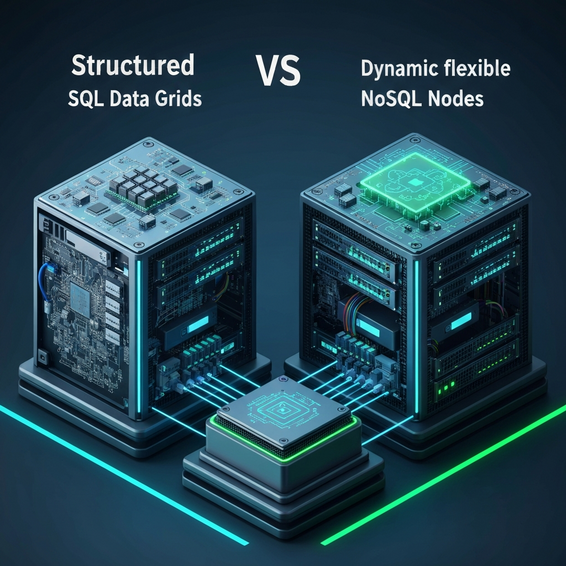
NoSQL powerhouses like Cassandra, DynamoDB, or MongoDB are generally built from the ground up to handle massive horizontal scaling out of the box. You should strongly consider them if your data structures are constantly evolving, you require lightning-fast write operations, or your application is okay with eventual consistency rather than demanding strict ACID compliance.
What is the role of a load balancer in database architecture?
Think of a load balancer as a traffic cop sitting right between your application and your database nodes. Its primary job is to distribute incoming query traffic evenly across your various read replicas. By doing this, it prevents any single database node from getting crushed under the weight of incoming requests, keeping performance incredibly smooth even during massive traffic spikes.
Conclusion
At the end of the day, wrapping your head around how to design scalable database architecture isn’t just a technical flex; it’s the absolute foundation of building robust, enterprise-grade software. If you don’t have a concrete plan for data growth, your application is eventually going to buckle under performance issues and frustrating outages.
Don’t rush to rewrite your entire backend overnight. Start small by making sure your everyday queries are optimized, your indexes are mapped out correctly, and a reliable caching layer like Redis is standing guard. These quick, easy wins will buy you a ton of valuable time.
Then, as your user base naturally expands, you can start gradually introducing read replicas to shoulder the burden of heavy read traffic. Eventually, when the time is right, you can push further into distributed systems, completely decoupled microservices, and advanced sharding to truly future-proof your tech stack. By proactively planning your database strategy today, you guarantee high performance, squash downtime, and keep your users happy with a consistently snappy experience.
About the Author