7 Best AI Workflow Automation Tools for Developers (2024)
Ask any software engineer, and they’ll probably tell you that actually writing code is the easiest part of their day. The real headache usually comes from everything else. You’re constantly juggling a never-ending stream of pull requests, hunting down sneaky bugs, wrestling with CI/CD pipelines, and churning out the exact same repetitive boilerplate. While these tasks are definitely necessary, they become massive bottlenecks that steal away precious hours you could be spending on actual feature development.
Thankfully, the recent explosion of artificial intelligence is fundamentally changing the way we build, test, and deploy software. The boost to overall developer productivity is nothing short of massive. Now, engineering teams have the power to ship products much faster while drastically cutting down on critical errors.
Tracking down and implementing the best ai workflow automation tools for developers is a surefire way to supercharge your daily routine. By tapping into advanced machine learning models, forward-thinking dev teams are starting to automate nearly everything—from basic code generation all the way up to full-scale infrastructure provisioning.
In this guide, we are going to unpack exactly why these development bottlenecks happen in the first place. From there, we’ll explore how to clear them out using both basic and advanced AI solutions, rounding things out with a look at the top tools you need to optimize your software development life cycle (SDLC).
Why Development Workflow Bottlenecks Happen
Before we jump straight into AI automation, we really need to understand why developer productivity tends to hit a wall. Surprisingly, these bottlenecks almost never happen because someone lacks coding skills. Instead, they usually bubble up from systemic inefficiencies baked right into the broader development lifecycle.
A major culprit on the technical side is an overly complicated continuous integration and continuous deployment pipeline. Think about it: when automated tests take hours to finish, or when you need a manual sign-off for every tiny commit, your deployment velocity is going to plummet. Combine that with the constant context switching between your IDE, ticketing systems, and chat apps, and it’s no wonder a developer’s cognitive energy gets completely drained by the afternoon.
Technical debt and legacy code maintenance also play a massive role in slowing things down. Developers end up wasting countless hours churning out boilerplate or playing detective to figure out what an undocumented legacy function actually does. Without some form of automation, code reviews turn into a tedious, slow-moving chore. This is exactly where modern AI developer tools shine, stepping in to solve these exact technical hurdles with incredibly fast, context-aware solutions.
Quick Wins: Basic AI Workflow Automation Tools
If you are just starting to weave AI into your tech stack, don’t worry—you don’t have to rip and replace your entire infrastructure on day one. Instead, try starting with a few quick, highly actionable steps that can easily help you reclaim hours of your work week.
- Automate Boilerplate Generation: Try installing an AI coding assistant directly into your IDE. Platforms like GitHub Copilot or Tabnine can predict and generate your boilerplate code almost instantly. This frees you up to focus on the actual, complex business logic rather than obsessing over basic syntax.
- Implement Smart Code Reviews: Hook up an AI review bot to your GitHub or GitLab repos. These handy tools will immediately scan any incoming pull requests to catch syntax errors, flag security flaws, and spot performance issues long before a human reviewer even opens the file.
- Automate Commit Messages: It’s time to stop writing vague commit messages like “fixed bug” or “updated stuff.” You can now use AI-powered CLI tools to analyze your git diffs and automatically spin up standardized, highly descriptive commit messages on your behalf.
- Streamline Bug Triaging: Bring AI plugins into your issue trackers, whether you use Jira, Linear, or something else. By understanding the context of what a user submitted, these tools can automatically tag, categorize, and assign new bug reports to the right person.
Even if you only implement one or two of these simpler solutions, you’ll notice a dramatic reduction in daily friction as your coding workflows become increasingly automated.
Advanced Solutions: AI for DevOps and IT Teams
Of course, if you’re a senior engineer or an infrastructure professional, basic code completion probably isn’t going to cut it. To genuinely scale your operations, you have to start embedding AI directly into your underlying architecture. Here is a look at how advanced IT teams are currently exploring DevOps automation.
CI/CD AI Integration and Remediation
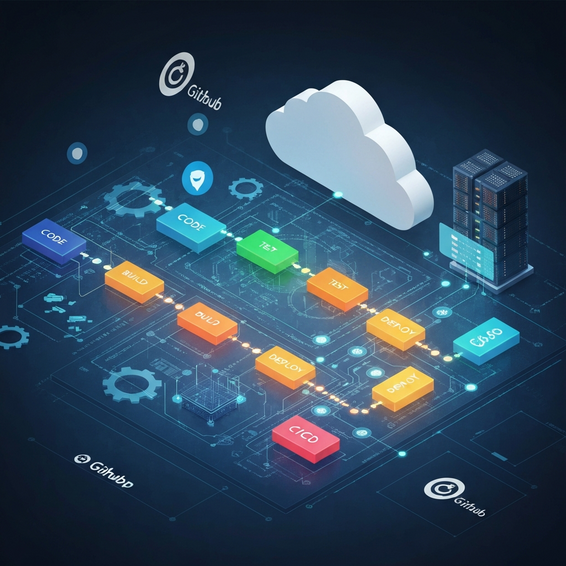
Whenever a build fails in a traditional pipeline, a developer usually gets stuck sifting through thousands of lines of terminal logs just to find a single error. Integrating AI into your CI/CD changes that completely by letting tools analyze the stack trace natively. If a failure pops up, the AI pinpoints the exact line of code causing the issue and can even automatically generate a pull request containing a suggested fix.
Automated Infrastructure as Code (IaC)
Let’s be honest: writing Terraform or Ansible scripts from scratch takes up a lot of time and leaves plenty of room for human error. Today’s AI workflow tools can actually take a simple natural language prompt and instantly spit out the exact IaC templates you need. On top of that, AI agents are able to scan these configurations for potential cloud security vulnerabilities before anything ever gets deployed to your server.
Dynamic Test Generation
Test-driven development (TDD) sounds amazing in theory, but we all know it often gets pushed aside when deadlines are looming. Modern AI automation solves this by ingesting your source code and automatically writing comprehensive unit, integration, and end-to-end tests for you. This guarantees robust code coverage without burying your team in heavy manual overhead.
How to Choose the Right AI Workflow Tools
Because hundreds of new AI applications seem to launch every single month, trying to pick the right platform can feel completely overwhelming. Ultimately, the best choice is going to depend heavily on the size of your team, your existing tech stack, and your specific security requirements.
A good first step is to sit down and evaluate your team’s biggest pain points. If everyone is spending way too much time reviewing code, you should prioritize review automation tools. On the other hand, if constant context switching is the primary issue, you’ll want to look for IDE-integrated assistants designed to keep your developers focused inside a single window.
Next, you need to weigh the pros and cons of self-hosted versus cloud-based solutions. If you are working on highly secure HomeLab setups or operating within an enterprise environment that has strict compliance rules, adopting self-hosted AI models is generally the best way to ensure maximum data privacy.
Best Practices for AI Developer Tools
There is no denying that AI automation offers incredible speed, but we have to acknowledge that it also introduces a set of brand-new risks. If you want to maintain a secure and highly performant development environment, it is crucial to always follow a few essential best practices.
- Keep a Human in the Loop: You should never allow an AI to push code straight into a production environment without some level of human oversight. It is much safer to treat AI outputs as high-quality rough drafts that still require a thorough architectural review.
- Secure Your Credentials: Make it a strict rule to avoid pasting sensitive data, hardcoded passwords, or highly proprietary algorithms into public AI models. Instead, lean on enterprise-grade tools that offer strong guarantees about keeping your codebase private.
- Standardize Your Prompts: Just as you have coding standards, you should also establish prompt engineering guidelines for your entire team. Getting everyone on the same page about how to ask an AI to generate tests or write code goes a long way in ensuring uniform output quality.
- Monitor for Hallucinations: Keep in mind that AI models will occasionally invent libraries or packages out of thin air. Always make sure that your package managers are strictly validating dependencies before installation, as this helps prevent dangerous software supply chain attacks.
Top Recommended Tools and Resources
Are you ready to actually upgrade your tech stack? To help you get started, here is a curated list of the absolute best tools you can begin using today to thoroughly optimize your daily workflow.
- GitHub Copilot Workspace: Going far beyond simple code completion, this tool acts as a native assistant designed to help you plan, build, and test applications directly within your existing GitHub repositories.
- CodeRabbit: This is a truly exceptional, AI-driven code review platform. It reads your code to provide deeply contextual feedback, cleanly summarize complex pull requests, and suggest highly actionable refactors.
- n8n: If you need a powerful, source-available workflow automation tool, this is it. It gives developers the freedom to build out custom, automated workflows that connect APIs, databases, and various AI models, all through a visual node-based interface.
- Cursor IDE: Cursor is quickly becoming a rising star in the developer productivity space. Because it is built from the ground up entirely around AI, it offers incredibly fast, deeply codebase-aware edits alongside clever terminal debugging.
- CodiumAI: Think of this as the ultimate tool for automated test generation. It actually analyzes your underlying logic and generates meaningful test suites, helping ensure your code behaves exactly the way it was intended to.
Frequently Asked Questions
Can AI fully automate my coding workflow?
The short answer is no; AI cannot fully automate the entirety of a developer’s workflow. While it absolutely excels at writing boilerplate, whipping up tests, and spotting syntax errors, it still lacks the broader architectural context and deep business logic comprehension needed to build complex software on its own. It is best to think of AI as an advanced junior assistant, rather than a total replacement for human developers.
What are the most secure AI tools for enterprise developers?
If you are an enterprise developer, you should exclusively look for AI tools that offer incredibly strict data privacy agreements. Solutions like GitHub Copilot Enterprise, Tabnine, and GitLab Duo are solid choices because they explicitly guarantee that your proprietary codebase won’t be secretly utilized to train public machine learning models.
Will AI automation replace DevOps engineers?
Not at all. AI-powered DevOps automation is not here to replace human engineers; rather, it is here to elevate their roles. By offloading mundane tasks like tedious log analysis and basic infrastructure provisioning, DevOps professionals are suddenly free to focus entirely on high-level system architecture, strengthening security postures, and optimizing overall cloud computing costs.
Conclusion
The entire landscape of software engineering is shifting at an incredibly rapid pace right now. Embracing automation is really no longer an optional luxury; it has become a strict necessity for any team that wants to ship code faster and with far fewer errors. By actively integrating the best ai workflow automation tools for developers into your daily routine, you can finally start to eliminate those deeply tedious manual tasks.
This massive shift takes a huge weight off your cognitive load, ultimately allowing you to spend a lot more time doing what you actually love: building truly great software. Don’t be afraid to start small by simply adding a reliable AI assistant into your local IDE. From there, you can progressively scale up to automated pull request reviews and fully integrated AI inside your CI/CD pipelines.
At the end of the day, the developers who take the time to master these automation tools today will undoubtedly become the engineering leaders of tomorrow. So, start optimizing your workflow right now, and get ready to watch your daily productivity absolutely soar.
About the Author